There’s books, videos, lectures, FAA WINGS seminars, and more on the time-honored traditions of the preflight inspection. But, not to reinvent the wheel, Three wants to break this down into three simple things as part of our new series aptly named Three Things.
Number 1: No.
Without a pilot, an airplane is just a collection of parts and pieces. Beyond the IMSAFE checklist, the FAA has made an alphabet soup of acronyms and memory aids to try to remember all the various aeronautical decision making strategies, checklists, and that’s not what we’re going to do here. Instead, let’s focus on the ability for you to say no. Can you say no to taking today’s flight? What justifications could you make for not flying? Are they threats that can be mitigated? Or is it easier just to just say no.
Number 2: Hmm.
Taking a look at the airplane, whether it be a personal, club, or rented airplane, the POH/AFM/FCOM will outline the requirements of the preflight inspection. And while they rarely go into obscene levels of detail, we at Three take a more simplistic approach to what some turn into an annual or conditional inspection. If there’s something that makes you go “hmm,” then maybe there’s something to help substantiate “Saying No” to the flight.
Number 3: Hey bud.
When in doubt, take a moment to expand your team. Something personally unsettling about the flight or the airplane? If you’ve haven’t established a strong working relationship with the airplane’s owner, mechanic, or a trusted confidant, mentor, or partner, then certainly now is not the time. But if you do have one, then at the least, a quick inquiry about any questions you may have, or a simple “just about to head out” message will help keep them in the loop.
Preflight inspections are moments where we’ve hopefully taken an honest look at the risks associated with ourselves, our aircraft, and our intended flight. The development of mitigation strategies to address these defined risks is something that every pilot should have in their quiver. That, and a mentor as mentioned above, can be instrumental in building confidence in our abilities. If you’re looking to help develop those skills, give us a shout.
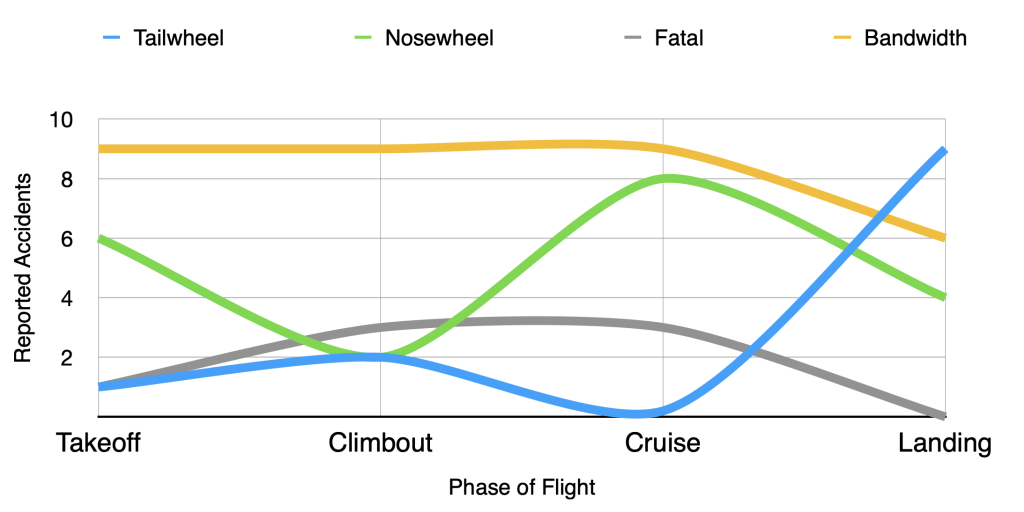
In 2023, there were 35 reported aircraft accidents in Utah. Researching each of these accidents in an attempt to categorize areas where pilots should improve their procedures and skills, the following representation of phase of flight to type of aircraft in relation to the commonly accepted decision making bandwidth available leads us to the following conclusions:
Accidents during the takeoff and climbout phases of flight illustrate a potential opportunity to improve upon pre-takeoff procedures.
Accidents during the landing phase of flight illustrate a need to focus on maintaining directional control in both nosewheel and tailwheel aircraft.
Accidents across all phases of flight help validate the need for pilots to learn how to manage time to mitigate unexpected threats.
Empower
Pre-takeoff Procedures
Many of the takeoff accidents reported in 2023 were caused by poor pilot technique. Whether it was an improper takeoff technique (the improper setting of mixture prior to takeoff at a high density altitude airport, the improper use of flaps during the takeoff sequence, the use of whatever the hell a “jump takeoff” is), setting ourselves up for a safe takeoff starts with a solid foundation of pre-takeoff checklists and takeoff briefings. Having our aircraft configured for takeoff prior to taking the runway would have alleviated a few of this year’s accidents. Takeoff briefings that include the plan of attack for any indication of reduced power on takeoff, or the complete loss of power on takeoff, should become normal procedure. Whether we test fate with the dreaded “impossible turn” or know what’s around our airports as far as potential suitable landing areas, better outcomes can come from better planning ahead of time.
For 2024, pilots should review their takeoff procedures after completing their run-up procedures. Verbally discussing the plan of action when a reduction of thrust on takeoff or a complete loss of thrust on takeoff situation presents itself should become common practice for every takeoff. And aiding in that briefing is a little reconnaissance of the surrounding area of your departure airport. Whether it be a drive around the neighborhood, or a review of satellite imagery, one should have chosen alternative emergency landing areas while identifying threats of power lines, towers, and other obstructions that could present hazards in a potentially hazardous situation.
2. Maintaining Directional Control
The threat of divergence on landing tailwheel aircraft will always be something pilots contend with. Whether it be unexpected winds or mechanical failures that drive some of these sequences to occur, in 2023 it appears as though many of our “ground loop” accidents were at the mercy of the pilot alone. One accident was due to a distraction caused by a passenger that likely took the pilot’s attention away from the landing sequence, while the majority of the others were due to a pilot’s actions being either not quick enough or too much too soon. Not to be completely overshadowed by the errant risk of tailwheel aircraft, nosewheel aircraft suffered similar divergences on landing, only one being caused purely by a failure of the landing gear system, while another was the sudden loss of one engine in the flare.
The lesson learned through all this data is that recognizing our abilities decreasing towards the end of flight should alert us that we need to better prepare ourselves for the unanticipated threats that may occur during landing. Additionally, making sure that we can focus solely on the approach and landing phase while not letting distractions, whether they be self-induced or not, impede our duties as Pilot in Command will allow us to continue to a safe landing regardless of what may have transpired.
3. Managing Time
Recognizing diminishing pilot abilities with the timeline of a flight, one can easily draw conclusions on causal factors with increased incidents and accidents towards the descent and landing phases. As the demand for our airmanship skills increase, it is imperative that as aviators we identify potential threats that may introduce themselves into flight and create meaningful and purposeful mitigation strategies to address these potential issues. Periods of low workload such as during cruise offer pilots ample opportunities to prepare for the next phases of flight.
Elevate
Let’s talk about how we can implement better planning and procedures into your personal flying missions today to avoid repeating the accidents of the past by contacting us today!